Everything a Pokémon card is willing to tell you about itself is printed in its bottom corners in type small enough to miss. Learn to read that strip and you can identify, date and roughly value a card from across a table, which is the skill the rest of the hobby is built on.
The bottom-left corner
The set symbol is a small picture that identifies the expansion. The set code, three or four letters beside the card number, says the same thing in text and is what every price site and checklist uses. The regulation mark, a single letter in a box, is for tournament legality and doubles as a rough date: the letter advances about once a year.
The card number
Written as a fraction: the card’s position over the set’s stated size. A number higher than the set size, 170/161 say, is a secret rare, which is a card the set holds beyond the count it prints on every other card. That is not a misprint. It is how the rarest cards announce themselves.
The rarity symbol
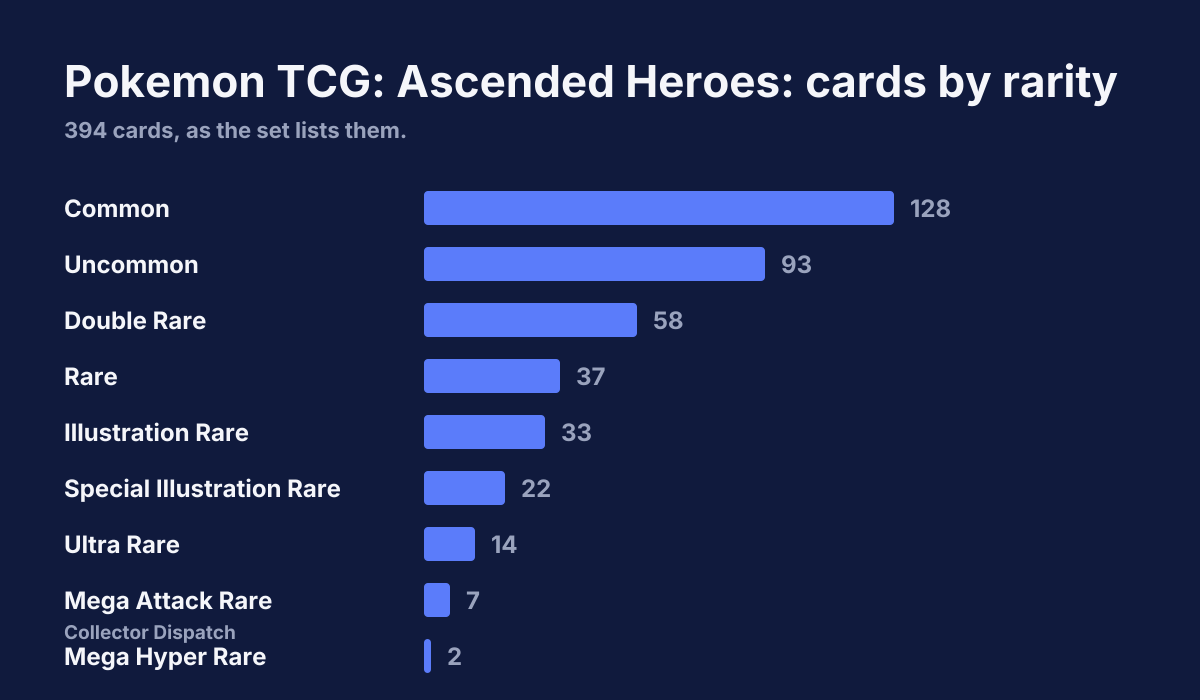
Beside the number: a circle for common, a diamond for uncommon, a star for rare, and multiple or stylised stars for the tiers above that. The tiers have multiplied in the current era. Pokemon TCG: Ascended Heroes has 394 cards across 9 rarity names, and 173 of them, 44%, sit above uncommon. 31 are in the tiers collectors chase hardest.
| What the card says | What it means |
|---|---|
| Common, Uncommon, Rare | The ordinary tiers; the bulk of any set. Commons alone are 128 of Pokemon TCG: Ascended Heroes’s 394. |
| Double Rare | A Pokémon ex: a playable card with a two-star mark, usually the set’s main competitive pulls. |
| Ultra Rare | Full-art versions of a Pokémon ex, supporter or trainer. |
| Illustration Rare | Alternate artwork of an ordinary card, at the ordinary card’s power. Bought for the picture. |
| Special Illustration Rare | Alternate, usually full-bleed artwork of an ex. The set’s most expensive cards live here. |
| Hyper Rare, Mega Hyper Rare | Gold-foil cards above the set count. Scarce, and often less wanted than a Special Illustration Rare. |
Holofoil, reverse holo and the rest
A holo has foil in the artwork window. A reverse holo has foil everywhere except the artwork, and exists for nearly every common and uncommon, which is why a set’s real card count is close to double what the number says. Neither is a rarity. They are finishes, and a reverse holo common is still a common.

Reprints and promos
A card reprinted in a later set carries that set’s symbol and number, and is a different card for pricing even when the art and text match. A promo carries a black star and a promo number instead of a fraction. Both trip up beginners who match a card to a price by its name alone. Match the set code and number, every time.
What Pokémon does not tell you
Pull rates. We hold 157,492 stated pull-odds ratios from manufacturers’ own sheets and none are Pokémon’s, because the company publishes none. The card tells you its rarity name. It does not tell you how often that rarity falls, and nobody who says otherwise has it from the maker.
Condition, read the same way
Tilt the card under a lamp. Scratches on the holo, whitening on the back edges and corners, and a centring that puts the border visibly off to one side are the three things a grader will see and a photograph will not. A card that reads mint at arm’s length is near-mint at most under a lamp, and that is the honest starting assumption for anything you have not examined yourself.
Putting it together
Set code, number over total, rarity symbol, regulation mark, finish. Five things, all on the card, that between them name it exactly. Our Pokémon checklists, 6 sets and counting, list every card by those five things, so once you can read them you can find anything.
Frequently asked questions
What does a card number higher than the set size mean?
A secret rare: a card the set holds beyond the count printed on every other card. It is deliberate, not a misprint.
Is a reverse holo rare?
No. Reverse holo is a finish, not a rarity. A reverse holo common is still a common; nearly every common and uncommon has one.
What is the regulation mark?
The single letter in a box at the bottom of the card. It governs tournament legality and advances about once a year, so it also dates the card roughly.
What are the pull rates for a rarity?
Pokémon does not publish them. We hold 157,492 stated pull-odds ratios from makers’ own sheets and none are Pokémon’s, so any figure quoted is an estimate.