"Limited edition" is not a quantity. It is a phrase, and it is used to describe print runs that differ from each other by a factor of a thousand. We hold 1,000 serial-numbered cards with a stated print run, and the range they cover is the whole argument.
What the numbers say
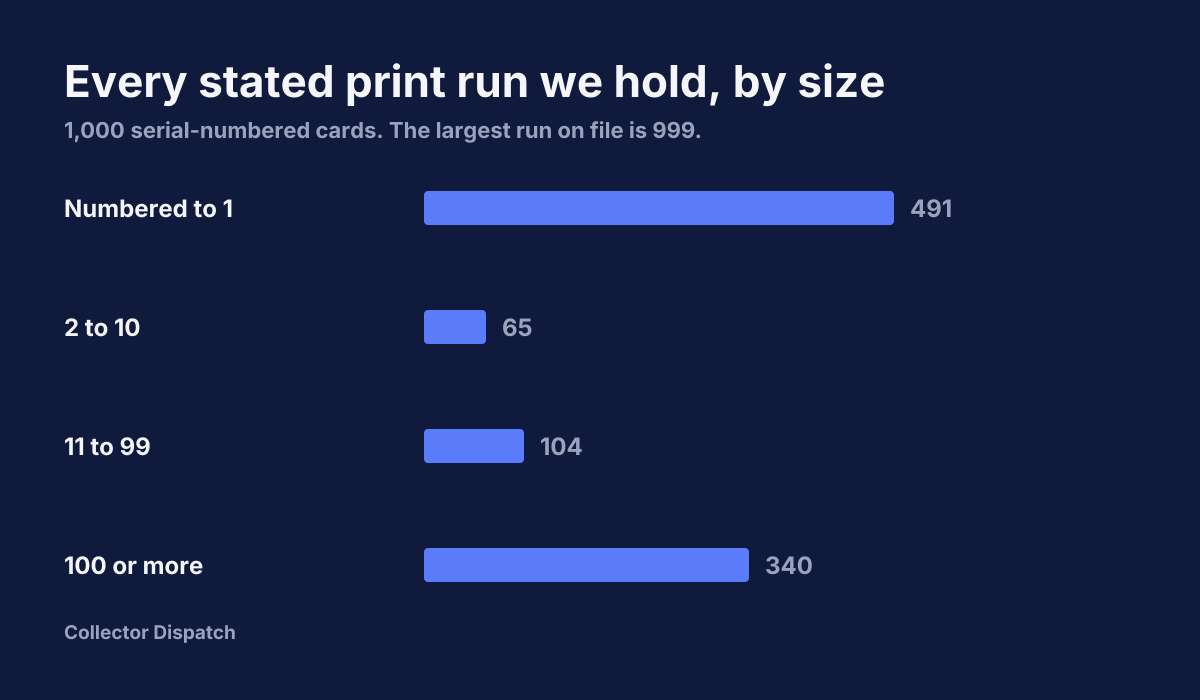
491 of those 1,000 cards, 49.1% of them, are numbered to one. 65 are numbered between two and ten. 104 sit between eleven and ninety-nine, and 340 are a hundred or more. The largest stated run we hold is 999.
Read that again, because it is the opposite of what the word implies. The one-of-one, the thing the phrase "limited edition" is supposed to evoke, is the most common kind of numbered card we have catalogued by a wide margin.
How that happened
Not by accident and not by conspiracy. A modern set has many parallels, and the rarest tier of each parallel is a one-of-one. Multiply a few hundred cards by a few dozen parallel tiers and you get tens of thousands of one-of-ones in a single year, each genuinely unique and collectively unremarkable.
A card numbered to one is not rare because it is numbered to one. It is rare, or not, depending on whether anybody wants that player in that parallel.
When "limited" means nothing
When the limit is not stated. If the packaging says limited edition and does not say limited to what, the word is doing marketing rather than describing. No number, no claim.
When the limit is large. A run of 999 is a limit. It is not scarcity, and the two get used interchangeably by people selling things.
When it is limited by time rather than quantity. "Available until the end of the month" means as many as can be made in a month, which is not a limit on anything a buyer cares about.
When it means a great deal
When the number is printed on the object, small, and attached to something people are already chasing. All three conditions, not one. The number alone tells you how many exist and nothing whatsoever about whether that matters.
What to ask instead
Not "is it limited" but "limited to how many, stated where, and how many people want one". The first question has an answer on every package. The last two have answers on almost none of them, and they are the ones that decide what the card is worth.
Frequently asked questions
Is a 1-of-1 card rare?
Only one exists, but they are not unusual. 491 of the 1,000 serial-numbered cards we hold are numbered to one, because the rarest tier of every parallel in every set is a one-of-one.
What is the largest "limited" print run?
The largest stated run on file is 999. That is a limit, and it is not scarcity.
How can I tell if "limited edition" means anything?
Ask what it is limited to, where that number is stated, and how many people want one. If the packaging does not give a number, the phrase is marketing.