The question collectors ask is which grading company is best. In 2026 the more useful question is which one is open, what it costs when it is, and what you are actually buying: a sealed slab a stranger will trust, a number for your own records, or something in between.
Three of the five services below were restricting submissions on the day we checked. One of them has had its website in maintenance for weeks. And one parent company now owns three of the biggest names in the business. Here is where each one stands, with every price read from the company's own page on 13 October 2026.
Disclosure. DCM Grading, covered in its own section below, is operated by the same people who publish Collector Dispatch. We have written about it because it is a genuinely different approach and readers ask about it, and we have tried to be as hard on it as on the others, including publishing what its own figures do not show. Judge the section accordingly, and read our disclosures page.
One owner, three of the biggest names
Start here, because it changes how you read everything else. Collectors, formerly Collectors Universe, owns PSA. It bought SGC in February 2024. In December 2025 it agreed to acquire Beckett, including Beckett Grading Services.
Collectors has said Beckett continues as a separate brand with its own operations, customer service, grading standards, marketplace, magazines and price guides, and that grading staff are not shared between the two. Taken at face value that is a meaningful separation. It is still one owner behind three of the names a collector is choosing between, and worth knowing when the advice you read says "get a second opinion from another grader".
| Service | Owner | Mails cards? | Sealed slab? |
|---|---|---|---|
| PSA | Collectors | Yes | Yes |
| Beckett (BGS) | Collectors, since December 2025 | Yes | Yes |
| SGC | Collectors, since February 2024 | Yes | Yes |
| CSG, now CGC Cards | Certified Collectibles Group | Yes | Yes |
| TAG | Independent | Yes | Yes |
| DCM | Independent | No | No |
PSA
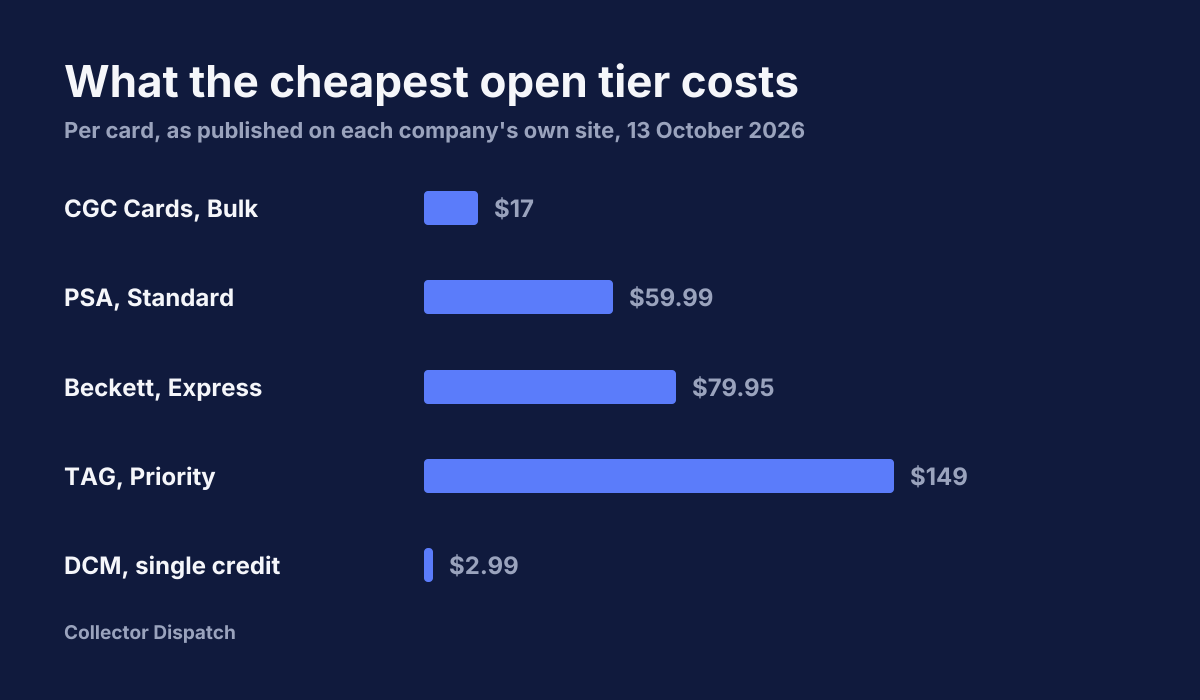
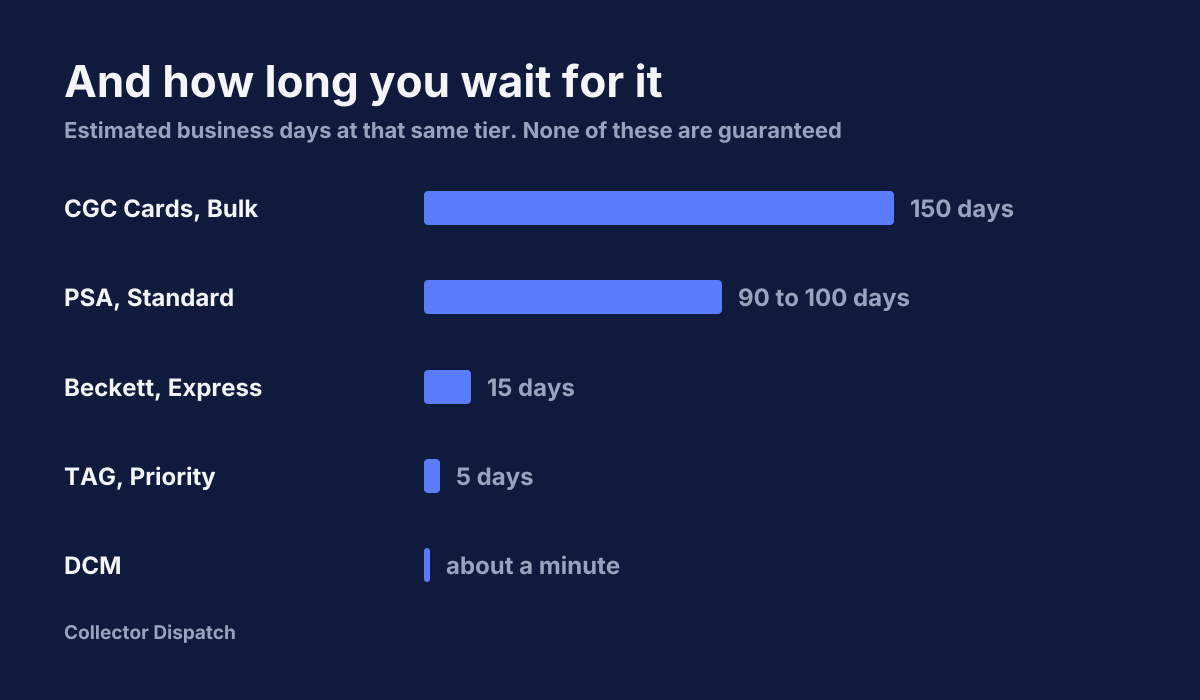
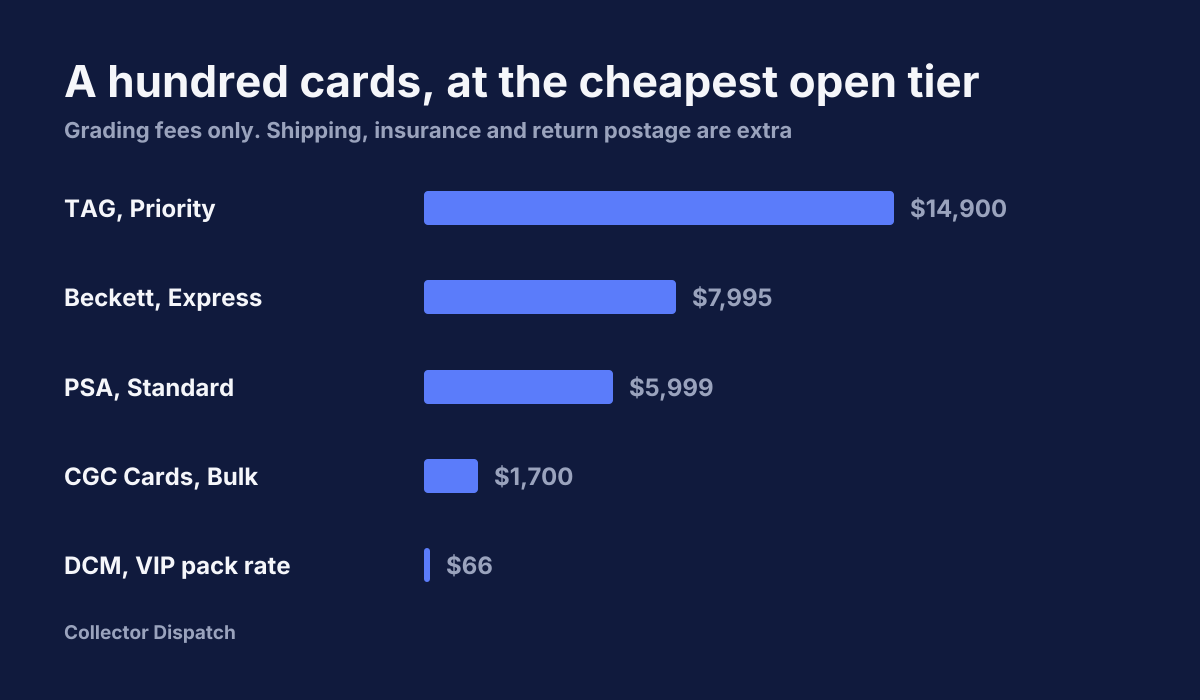
Still the default, and the one whose slab carries the most weight when you come to sell. On 13 October 2026 its own site carried the line "Value Services Are Temporarily Paused", which is why the cheapest thing you can buy is Standard at $59.99 per card, insured to $1,000, with an estimated 90 to 100 business days.
Above that: Priority $79.99 and 70 to 80 days, Express $199 and 20 to 30 days, Super Express $349 and 10 to 15 days, Premier $599 and 7 to 10 days. The estimates are PSA's own and it does not guarantee them.
What the money buys beyond a grade is the part people underrate. The card comes back sonically sealed in a tamper-evident case with the PSA LightHouse label, and with it comes the Set Registry, a published price guide and a sold-price archive. That infrastructure is why a PSA number travels further than any other, and it is the single strongest argument for paying the most and waiting the longest.
Best for: anything you intend to sell, anything vintage, anything where the buyer is a stranger. Worst for: bulk, modern commons, and anyone in a hurry.
Beckett (BGS)
Beckett is the subgrade company: centering, corners, edges and surface scored separately, which tells you why a card got the grade it got rather than only what the grade is. For condition-sensitive modern cards that detail is genuinely useful, and the Black Label 10 remains one of the hardest things to earn in the hobby.
It is also the hardest of the five to buy from right now. On 13 October 2026 beckett.com redirected to a maintenance site announcing that Base and Standard card grading submissions are "temporarily paused, in line with our dynamic approach to service availability", with a waitlist for both and Express available through a temporary submission form. Beckett's own page does not print the Express price; trade coverage through September and October puts it at $79.95 per card with a 15 business day estimate, subgrades included. Treat that as reported rather than confirmed, and check the form before you pay.
Best for: modern cards where subgrades matter, and anyone chasing a Black Label. Worst for: anyone who wants to know the price before they commit.
CSG, which is now CGC Cards
If you are looking for CSG, it no longer exists as its own brand. Certified Collectibles Group merged Certified Sports Guaranty into CGC Trading Cards in mid-2023, and everything now grades as CGC Cards. Old CSG slabs are still in circulation and still legitimate; they are simply a discontinued label.
Two changes came with the merger that still catch people out. Subgrades were dropped. And the old Gem Mint 9.5 is treated as equivalent to the Gem Mint 10 in population reports, with the Perfect 10 designation retired, so a 9.5 and a 10 from different eras are not the clean comparison they look like.
What CGC has going for it is price at volume. Its own fee chart on 13 October 2026: Bulk $17 per card with a 25-card minimum, insured to $500, 150 working days. Economy $20, insured to $1,000, 90 days. Standard $55 and 10 days. Express $100 and 5 days. WalkThrough $300 and 2 days. Members save 10 to 20 per cent. Nothing else in this comparison grades a mailed card for $17.
Best for: bulk submissions, TCG, and anyone who cares more about a sealed slab than about which logo is on it. Worst for: speed at the cheap end, and anyone expecting subgrades.
TAG
TAG is the one doing something technically different. Cards are imaged and assessed by machine rather than by eye, and you get back far more than a number: a 1 to 10 grade, a 1000-point score, a global rank for that card against every other copy TAG has seen, and a report naming the specific defects by corner, edge, surface and centering, with stereoscopic imaging and a 360-degree video. If you have ever wanted to know precisely why a card is a 9 and not a 10, this is the company that answers.
The cost of that is capacity. On 13 October 2026 TAG's pricing page was headed "limited reopening" and carried a backlog tracker. Basic was marked "currently at capacity" with a 75+ business day estimate and a notify-me button. The two tiers you could actually buy were Priority at $149 per card, insured to $2,500, estimated at 5 business days, and Walkthrough at $299, insured to $5,000, at 2 to 3 days, both marked limited slots. Insurance carries no value upcharge, and card care and archival UV encasing are included.
Best for: a small number of high-value cards where the detail of the report is worth $149. Worst for: volume, and anyone who needs a guaranteed slot.
DCM Grading
DCM is the odd one out, and the reason is simple: the card never leaves your house. You photograph it, DCM assesses the photographs against its own published standard, and about a minute later you have a grade, a condition report naming what it found, and a label you can print and slab yourself. There is no mailing, no minimum and no queue.
Pricing on 13 October 2026: a single credit is $2.99, five are $9.99 ($2.00 each), twenty are $19.99 ($1.00 each), and a 150-credit VIP pack is $99, which works out at 66 cents a card. A Card Lovers membership is $49.99 a month for 70 credits. Two grades are free to start and credits do not expire. One credit grades one card, and every grade includes the report and the printable labels.
The labels are the part collectors respond to. You choose the design, and the slab on your shelf is one you assembled rather than one that arrived. For a collection that is never going to be sold, that is arguably the whole point, and nobody else in this comparison offers it.
Now the limits, which DCM states itself and which matter more than anything above. It does not authenticate: nothing in the process establishes that a card is genuine, and that is the first thing a mail-in grader does. It does not encapsulate, so there is no tamper-evident seal and no chain of custody. And its own site says its grades are "not intended to replicate or predict grades from other grading companies such as PSA, BGS, CGC, or SGC". A DCM 9 is a DCM 9. It is not a forecast of a PSA 9, and treating it as one is the mistake to avoid.
What it is genuinely good at is the triage problem everyone with a big collection has. Grading 500 cards at PSA is $30,000 and a year. Grading 500 cards at DCM is about $330 and an afternoon, after which you know which twenty are worth mailing.
Best for: cataloguing a collection, deciding what to submit, and slabbing cards you intend to keep. Worst for: anything you plan to sell to someone who has not met you, and anything whose authenticity is in question.
What happens when you sell
This is where the comparison gets thin, and not because nobody has looked. There is no published, methodologically transparent study of what graded cards fetch against raw ones across the industry. The guidance in circulation comes from blogs and calculators, their numbers disagree with each other by wide margins, and several of them are published by companies that sell grading.
What is reliably true is narrower than the advice suggests. The premium concentrates in vintage and in the top grades. On modern cards a mid grade frequently does not recover the fee, and a PSA 10 that exists in its thousands is worth less than a PSA 10 that exists in its dozens. PSA's own Auction Prices Realized and Set Registry are the best public record of what slabbed cards actually sell for, and that record is itself part of what you buy.
Of the five companies here, exactly one publishes a monthly report of what its own graded cards sold for, with its method written down: DCM. It is marketing, published by the company whose product it measures, and the sample is six cards. It is also the only numbers in this article that come from completed sales rather than a price list, so here is what it says.
In September 2026, six DCM-graded cards sold on eBay. Four of the six beat the average raw sale of the same card. The typical sale was 40 per cent above the raw average, a median gain of $4.66 a card. Against PSA at the same grade number, DCM cards fetched about 59 per cent of the PSA price, and one of the six beat it.
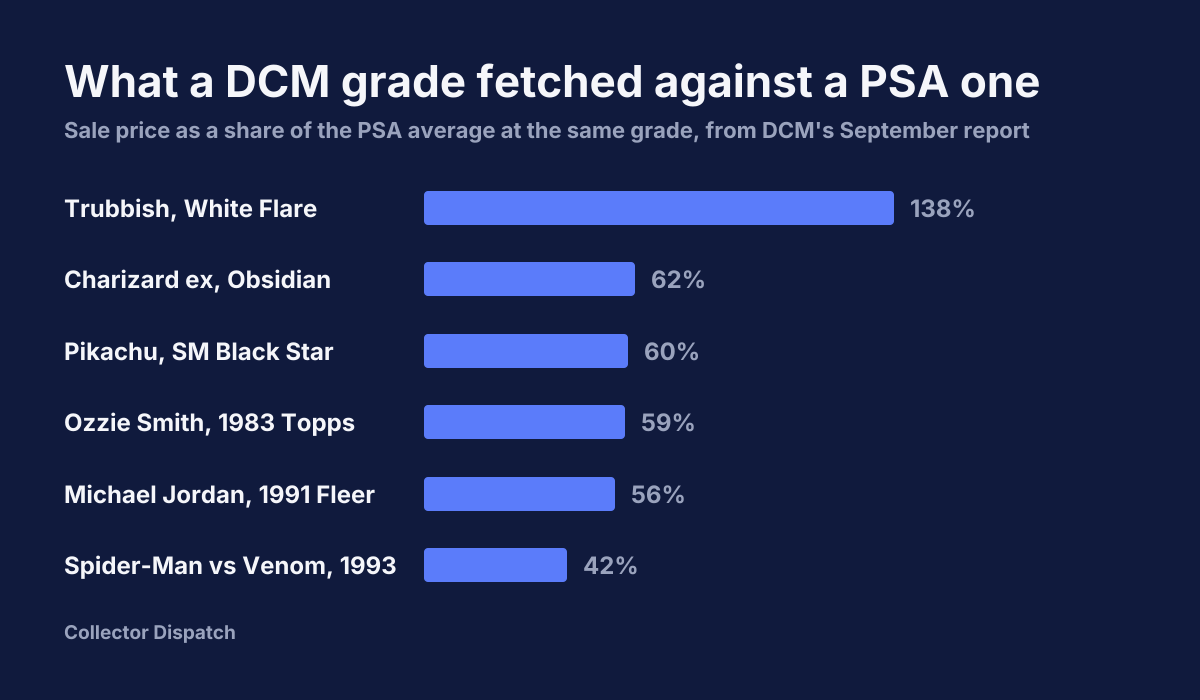
The split inside those six is the useful part. On cards averaging under $20 raw, the DCM sales came in 247 per cent above the raw average across three cards. On cards at $20 and above, the same figure was 11 per cent across three cards. A printed grade and a label help a cheap card look like a considered object. They do not turn a $176 card into a $700 one.
DCM's own method excludes any listing that mentions DCM from the comparison set, trims the top and bottom 10 per cent of comps, requires at least three raw and two PSA sales per card, and threw out 29 sales that did not qualify. The report also says plainly what it cannot control: sellers submit their best copies, while the raw comparison includes every condition, so part of the gain is the card rather than the grade. That caveat is doing real work, and six cards is six cards.
So which one
If you are selling, PSA, and the question is only whether the card clears the fee. For most modern cards under about $100 raw it does not.
If you have volume and want sealed slabs, CGC Cards at $17 a card is the only economical way to do it, provided you can wait 150 working days.
If you want to know exactly why a card graded as it did, TAG, for the handful of cards where $149 is proportionate.
If subgrades are the point, Beckett, once you can find out what it costs.
And if the cards are staying with you, DCM is the only option on this list that does not involve posting them to a warehouse and waiting three months to find out what you own.
Most collections need more than one of these, in that order: grade everything cheaply, then mail the few that earned it.
How we checked
Every price, tier, insurance limit and turnaround estimate above was read from each company's own published page on 13 October 2026 and is quoted as stated. Turnaround figures are each company's own estimates and none of them are guaranteed. Where a figure could not be read from the company itself, the article says so and names what it relied on instead. Ownership is from trade reporting of the Collectors acquisitions of SGC in February 2024 and Beckett in December 2025. The resale figures are from DCM's own published September report, with its method and its limits described above. We do not publish valuations, and nothing here is a view about what any card will be worth.