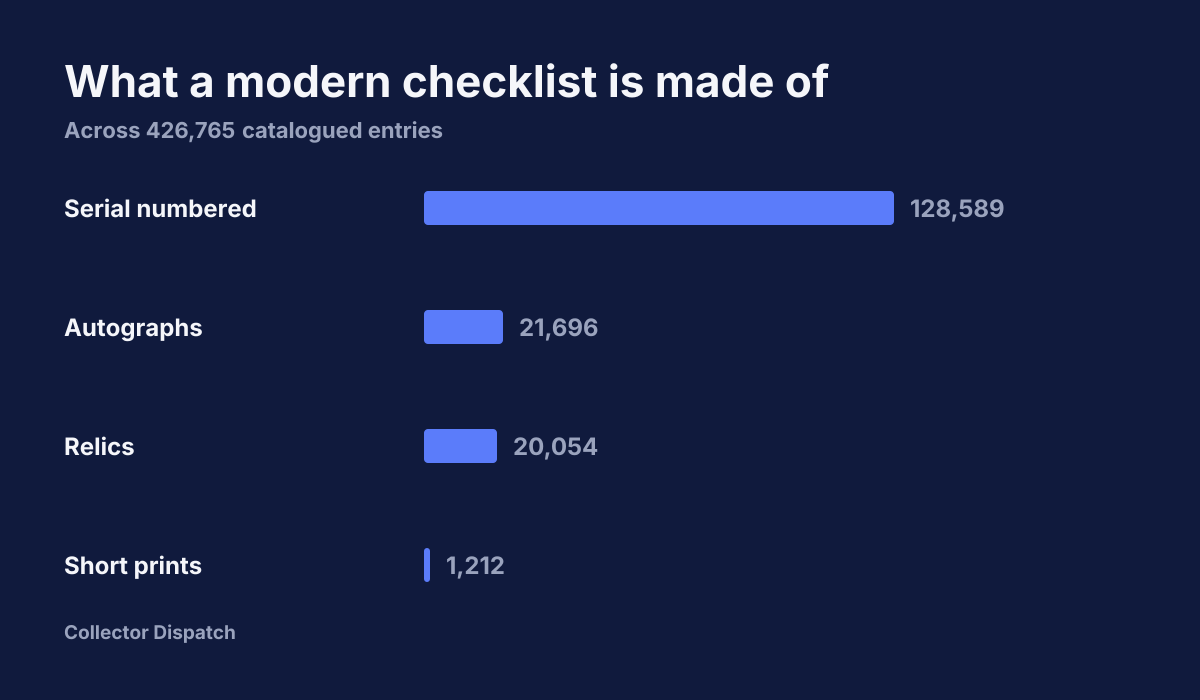
A checklist is the most reliable document in this hobby. It comes from the manufacturer, it is published in writing, and it commits them to something. We hold 313 of them covering 426,765 cards.
It is also read as saying far more than it does. Four things in particular are routinely inferred from a checklist that no checklist contains.
It does not say how many were made
Unless a card is serial numbered, no quantity appears anywhere. 128,589 of our 426,765 entries carry a stated print run, which leaves the majority stating nothing.
A card with no number is not therefore common. It is unstated, which is a different condition and a more frustrating one. The absence of a number is not evidence either way, and treating it as evidence of abundance is as wrong as treating it as evidence of scarcity.

It does not say what survived
A checklist describes what was printed. Cards are opened, bent, graded, lost, and sometimes destroyed deliberately, and none of that appears on any sheet. The gap between what was printed and what exists today is real, it grows every year, and nobody publishes it.
For older products this gap is the whole story, and it is the reason print run alone is a poor guide to how often you will see something.
It does not say how a card will be graded
Nothing on a sheet describes centring, surface or corners, and those are decided by the printing and packing rather than by the checklist. Two copies of the same entry, with the same number, can be meaningfully different objects, and the document that lists them cannot tell them apart.
This is why a print run of fifty is not the same as fifty interchangeable cards. The checklist counts entries. Condition happens afterwards, to each one separately.
It does not say what anything is worth
We do not publish valuations, and a checklist is not one. Where we show a price it is a manufacturer's stated price or a retailer's asking price at a stated time, which is a different thing from what something sold for, and a very different thing from what it will sell for.
It does not always say the set is finished
Checklists are published before products ship and revised afterwards. Redemptions can stay outstanding for a long time, and a set total can remain unconfirmed well after release.
Our checklist pages say when a total has not been confirmed rather than printing a number that reads as settled. An unconfirmed total is not a gap in our data; it is the state of the product.
What it does say
Precisely what the manufacturer committed to in writing: which cards exist, in which finishes, with which stated numbers and which stated odds. That is a narrower claim than it is usually read as.
It is also the most solid ground available in a hobby where most of the confident numbers come from somewhere else entirely. A checklist that says less than you wanted is still the document worth trusting.
How to use one anyway
Read it as a boundary rather than an answer. It tells you what cannot be true: a card that is not on the checklist does not exist in that product, a finish that is not listed was not made, and a print run that is stated is not negotiable.
Everything else, including every number anyone quotes about survival, population or price, comes from outside the document and should be attributed to wherever it came from. Our own figures are no exception, which is why each of our articles says what it counted and when.
Frequently asked questions
Does a checklist say how many cards were printed?
Only for serial numbered cards. 128,589 of the 426,765 entries we track carry a stated print run; the rest state nothing.
Do checklists change after release?
Yes. They are published before products ship, revised afterwards, and redemptions can stay outstanding for a long time.
Do you publish card values?
No. Where we show a price it is a stated manufacturer or retailer price at a stated time, not a sold price.