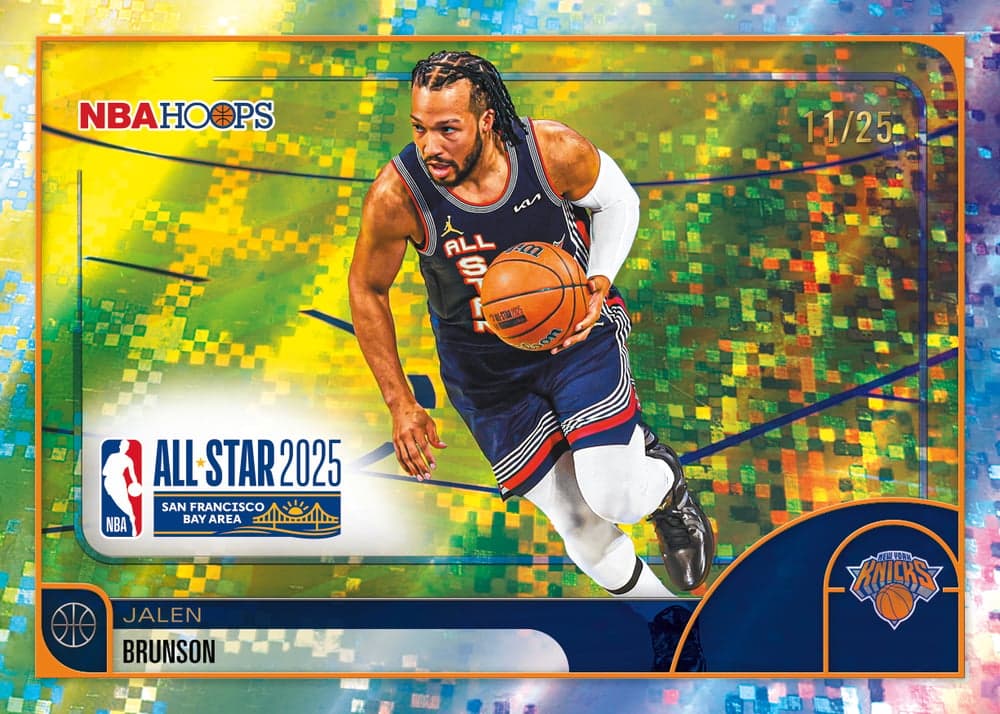
DCM Grading is a web and phone service that grades a trading card from two photographs. You shoot the front and the back, its system scores centring, corners, edges and surface, and about a minute later you have a whole-number grade from 1 to 10, a written condition report, and a label file you print and put in a holder you already own. The card never leaves your house, nothing is sealed, and the cheapest grade is $2.99. All three of those are the point, and all three are also the limit.
Disclosure. DCM Grading is operated by Dynamic Collectibles Management LLC, the company run by the people who publish Collector Dispatch. The App Store lists the app’s developer under a name that also appears on bylines here. We are not independent of this product and no wording can make us so. What we can do is read it the way we read HoloTap: everything below comes from DCM’s public site, its App Store and Google Play listings on 2 November 2026, and from its own published list of what a photo cannot see. We did not grade a card for this piece. Read our disclosures page, and read this one harder than usual.
What it is
A grade is produced by a system DCM calls Optic. Its accuracy page describes six steps, and the ones that matter are these. The card is evaluated three separate times against a published rubric, and the final grade is the median of the three, so one bad read cannot set it. Corners and edges are re-examined on magnified crops. Each of the four categories is scored on the front and the back separately and takes the lower face, and the overall grade is the lowest of the four subgrades. Nothing averages upward: a card with three 10s and a 7 is a 7.
Every grade also carries an image confidence letter from A to D and an uncertainty range, which is the part most photo graders leave off and the most useful thing on the report. A C or D is DCM telling you the photographs were not good enough and to shoot again. A card in a sleeve or a slab usually scores a B or C for that reason alone.
The rubric is published on the site, every grade resolves to a public page by its serial number, and the whole grade distribution is open on a population report. On 2 November 2026 that page said its counts were being refreshed and showed none, twice, twenty minutes apart; on 3 November 2026 it loaded, counted live from the grading database, and this is what it showed.
What the population report says
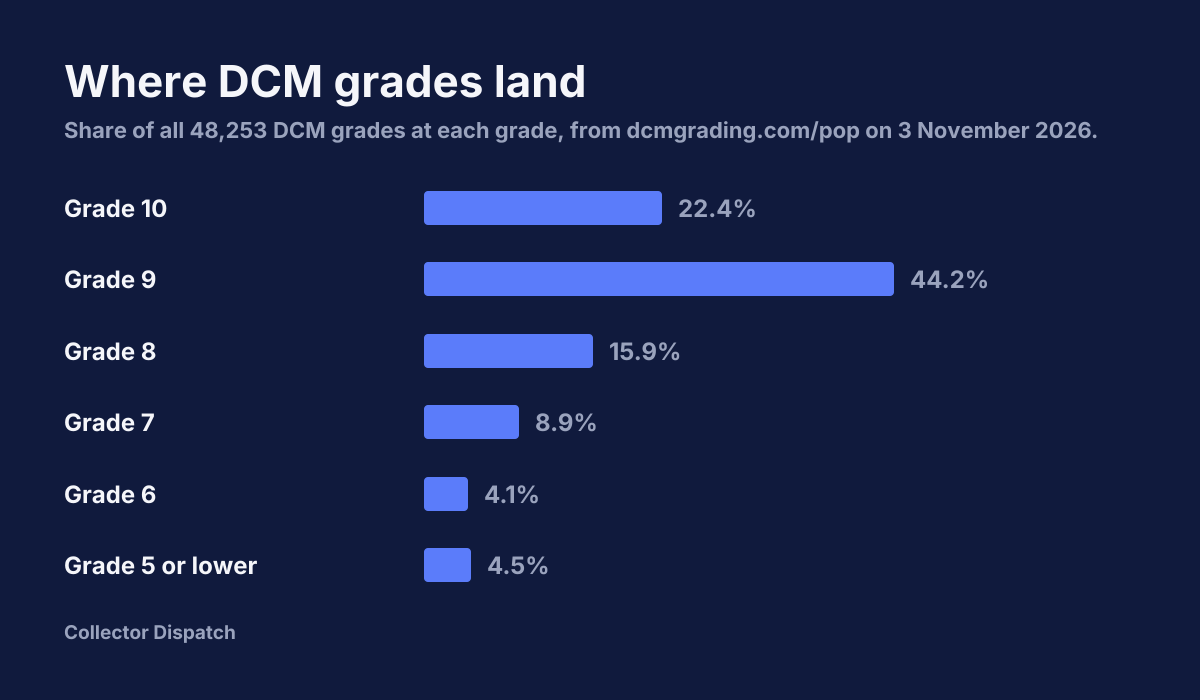
DCM had issued 48,253 grades on 29,344 different cards in 38 categories. 22.4% of them were 10s and 44.2% were 9s, so 66.6% of everything DCM has graded sits at 9 or better, and fewer than one grade in a hundred is a 3 or lower. That is a generous curve, and two things explain it without the rubric being soft. People photograph the cards they think are good, so the pool is self-selected in a way a mail-in grader’s submissions are too, only more so when the grade costs three dollars. And the page says, in its own footer, that these are DCM grades only and not a population count for any other company, so the shape cannot be laid over a PSA report and read as the same thing.
The category split is the more useful table, because it shows the standard being applied unevenly across the hobby in a way that matches how the cards are made. Among categories with at least 250 grades, football cards reach a 10 34.6% of the time and Yu-Gi-Oh! cards 15.1%; Pokémon, the biggest category by far, sits at 19.9%. DCM’s own explanation, from an analysis of its v8.6 grades it cites on the page, is that centering is the subgrade that most often caps the card, and the trading-card printers centre worse than Topps and Panini do.
| Category | Cards graded | Graded 10 | Rate of 10s |
|---|---|---|---|
| Yu-Gi-Oh! | 298 | 45 | 15.1% |
| Baseball | 11,484 | 1,944 | 16.9% |
| Hockey | 542 | 103 | 19.0% |
| Magic: The Gathering | 756 | 147 | 19.4% |
| Pokémon | 14,375 | 2,855 | 19.9% |
| Basketball | 7,133 | 1,511 | 21.2% |
| Soccer | 332 | 98 | 29.5% |
| One Piece | 373 | 111 | 29.8% |
| Football | 9,752 | 3,374 | 34.6% |
What you get for a credit
One credit grades one card: four subgrades, a written reason for every deduction, a serial, and access to Label Studio, which lays out a label for a graded slab, a magnetic one-touch or a top loader in one of three styles and gives you a print-ready PDF sized to a named Avery sheet. The slab, the one-touch and the sheet are yours to buy; DCM links them through Amazon affiliate pages and sells no supplies of its own. Graded cards sit in a collection with a portfolio view that estimates value from PriceCharting, SportsCardsPro, Scryfall and eBay asking prices, refreshed weekly.
Then there is InstaList, which is the feature that explains the rest of the product. It connects to an eBay account, builds a listing for a graded card with the label images and the mini report, and fills eBay’s graded-card fields, grader, grade and certificate number, with DCM’s. DCM takes no cut of the sale. This is what the grade is for, in the company’s own telling: a condition statement a buyer can check, attached to a listing, at a price that makes sense on a $12 card.
What it costs
| Package | Price | Grades | Per grade |
|---|---|---|---|
| Single credit | $2.99 | 1 | $2.99 |
| 5 credits | $9.99 | 5 | $2.00 |
| 20 credits | $19.99 | 20 | $1.00 |
| VIP, 150 credits | $99 one-time | 150 | $0.66 |
| Card Lovers, monthly | $49.99 a month | 70 | $0.71 |
| Card Lovers, annual | $449 a year | 900 | $0.50 |
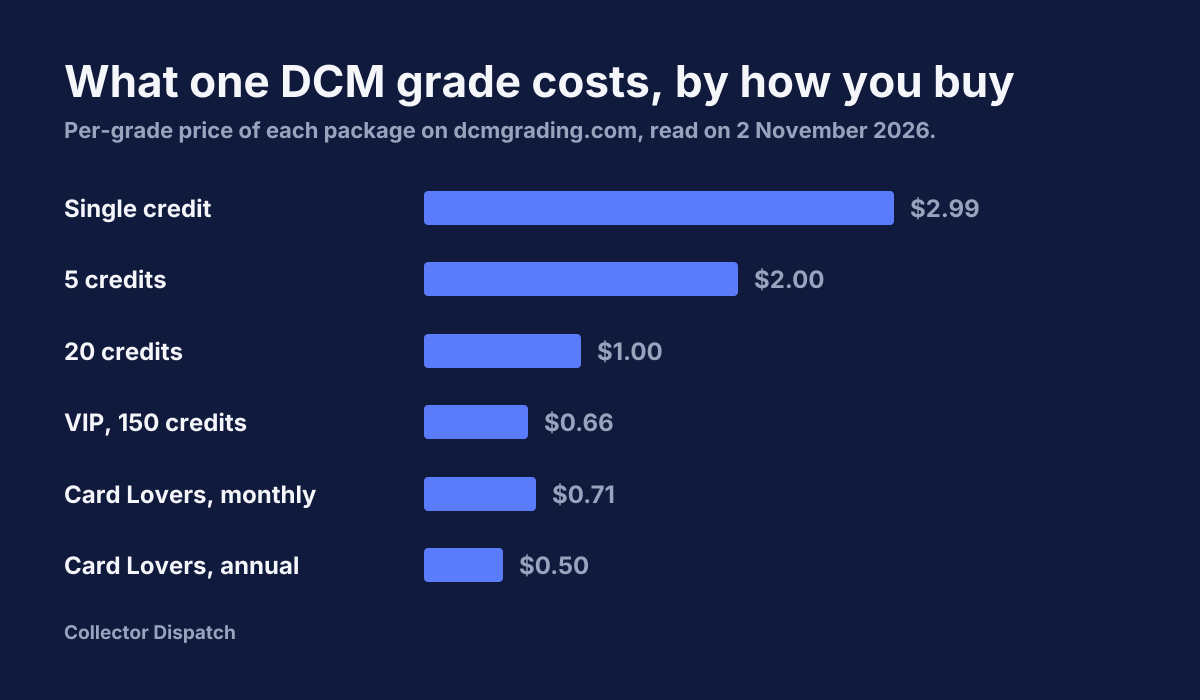
Two grades are free on sign-up. Credits from packs and the membership never expire. The annual membership is the cheapest per grade and also $449 up front, which only makes sense for someone who will grade several hundred cards; the 150-credit pack at $99 is the realistic bulk buy. The App Store lists the same pack at $99.99 and the website at $99, a dollar’s difference that is presumably Apple’s. A separate Enterprise tier for shops starts at $199 a month for 400 grades, with the shop’s own branding on the labels, and a Founders programme with its own discount closed to new members in February 2026.
The apps
The iPhone app is 45.3 MB, filed under Entertainment, needs iOS 15.1 or later, is rated 4+, and lists its developer as Douglas Mankiewicz. Its version history shows three releases, 1.0.1 on 19 May, 1.0.2 on 5 August, 1.0.3 on 6 October 2026, and on 2 November 2026 it had a score of 5.0 from 1 rating. The Android app showed 500+ downloads, 3.5 from 6 reviews, last updated 5 October 2026. Those are small numbers. This is a young product with few public users, and the website, which does everything the apps do, is where most of it lives.
Where it stops
DCM publishes its own list, and it is the right list, so here it is. A photograph cannot see warping or bowing. It cannot judge card thickness or stock, which is how reprints and counterfeits are caught, so DCM does not authenticate a card and says so. It cannot feel texture, raised bumps or a soft corner. It misses hairline scratches that show only at an angle. It cannot detect trimming or restoration, which need the card in hand under raking light. It cannot smell smoke. A signature is designated as present and graded around, never authenticated. And there is no slab: the label goes in a holder you own and can open, so there is no chain of custody and the grade is not registry-eligible anywhere.
Put those together and the shape is clear. DCM is a condition read, done consistently, cheaply and with its doubt printed on the label. It is not a guarantee of anything a stranger buying an expensive card needs guaranteed, and the day that stranger needs to know the card is genuine, untrimmed and unopened since grading, the answer is still a mail-in slab.
The claim we would push back on
DCM’s footer says its grades are not intended to replicate or predict those of PSA, BGS, CGC or SGC. Its about page says it also shows estimates of what those companies might assign, labelled as projections. Both statements are careful, and they sit uneasily together, because a projection of a PSA grade is a prediction of a PSA grade whatever the label calls it. We would rather the projections were not there. A reader who has got this far should treat them as the least reliable number on the report.
The evidence it offers
The homepage leads with sale results: DCM 10s sold for about double the raw price, sports cards at DCM 8 or higher sold 88 per cent above raw, 9s and 10s 31 per cent above, each against a trimmed mean of ungraded eBay sales of the same card within 180 days. The method is stated, which is more than most such claims manage, and the footnote says the premiums are largest on cheap cards and that lower grades often sell below raw. What the homepage does not say is how many sales are behind the percentages. The one dated report we have read, for September 2026, covered six cards, and against PSA at the same grade number those six fetched about 59 per cent of the PSA price. Our grading guide went through that report in detail. Until a larger, dated sample is published, read the homepage figures as marketing with a method attached.
Against the field
DCM’s own comparison page lists the mail-in graders with a check date of 8 October 2026. These are its readings, reproduced as such; the point is the shape, not the pennies.
| Service | Cheapest open tier | Price | Turnaround | What you get |
|---|---|---|---|---|
| PSA | Standard; Value services paused | $59.99 | 90 to 100 business days | Human graders, sealed slab |
| Beckett (BGS) | Express; Base and Standard paused | $79.95 | 15 business days | Human graders, sealed slab |
| SGC | Standard | $50 | 40 or more business days | Human graders, sealed slab |
| CGC | Economy | $20 | 90 business days | Human graders, sealed slab |
| TAG | Limited reopening | On its site | On its site | Human graders with imaging, sealed slab |
| DCM | Single credit | $2.99 | About a minute | Photo-based, no slab |
The mail-in services are paused, waitlisted or three months out at the cheap end, which is the market DCM is built for. Nothing else in the table grades from a photograph, and nothing in it costs under $20. The honest comparison is not DCM against PSA on one card you are selling. It is DCM against doing nothing on the four hundred cards you were never going to mail.
What we would use it for
Triage, first. Five hundred cards at the cheapest open PSA tier is $30,000 and the better part of a year; five hundred at DCM’s bulk rate is $330 and an afternoon, after which you know which twenty deserve the slab. Cataloguing, second: a consistent condition note on every card in a collection, with a label that matches, is something no mail-in service will ever do at that price. Selling cheap cards, third, where a stated grade with its photographs attached is better than “near mint” typed by the seller, and where the buyer is not relying on authentication.
What we would not use it for is the card where the money is. A $400 card goes to a mail-in grader, for the seal and the authentication and the name on the flip, and DCM says as much in its own limitations.
The verdict
Judged as what it claims to be, a fast, cheap, documented condition read with a label, DCM does the job and is unusually honest about where the job ends. Judged against a sealed slab from a grader with thirty years of market trust, it is not that and does not pretend to be. The weak points are the ones a young product has: a population report that was down the first day we looked and up the next, resale claims without a sample size, and a projection of other companies’ grades that the company’s own footer argues against. Put a sample size on the resale claims and drop the projections, and it would be a service we could recommend without this many qualifications. We are the wrong people to make that recommendation, which is why this piece is built from what DCM publishes rather than from what we think of it.
Frequently asked questions
Is a DCM grade the same as a PSA grade?
No, and DCM says so in its own footer: its grades follow its own published standard and are not meant to replicate or predict PSA, BGS, CGC or SGC. A DCM 9 is a DCM 9.
Does DCM authenticate cards or autographs?
No. It grades condition from photographs. Its own limitations page says card thickness, stock and trimming cannot be assessed from an image, and signatures are designated, not authenticated.
How much does DCM cost?
On 2 November 2026: $2.99 for one grade, $19.99 for 20, $99 for 150, and $449 a year for 900 on the annual membership, which is $0.50 a grade. Two grades are free on sign-up and credits do not expire.
What share of DCM grades are 10s?
22.4% of the 48,253 grades on DCM’s population report on 3 November 2026, and 66.6% were a 9 or a 10. The rate varies by category, from 15.1% for Yu-Gi-Oh! to 34.6% for football. These are DCM grades only, not a population count for any other grader.
Do I get a slab?
No. You get a digital grade, a report and label files you print yourself for a holder you already own. DCM does not encapsulate anything, and a DCM-labelled holder can be opened.
Who makes DCM Grading?
Dynamic Collectibles Management LLC, which is run by the same people who publish Collector Dispatch. That is why this review carries a disclosure at the top and leans on DCM’s own published limits.