
Grading is a service with a price, and the question is the one you would ask of any service: does it return more than it costs. For most cards it does not. For a few it does, clearly. This is how to tell which you are holding before you pay to find out.
Disclosure. DCM Grading, mentioned below, is operated by the same people who publish Collector Dispatch. We have written about it because it works differently from the others and readers ask about it, and we have tried to be as hard on it as on anyone else. Read our disclosures page.
What you are paying
These are the cheapest tiers each company was actually accepting on 13 October 2026, read from its own site. Several had cheaper tiers paused, and a price you cannot buy is not a price. The full comparison, with waits, is in our guide to the grading companies.
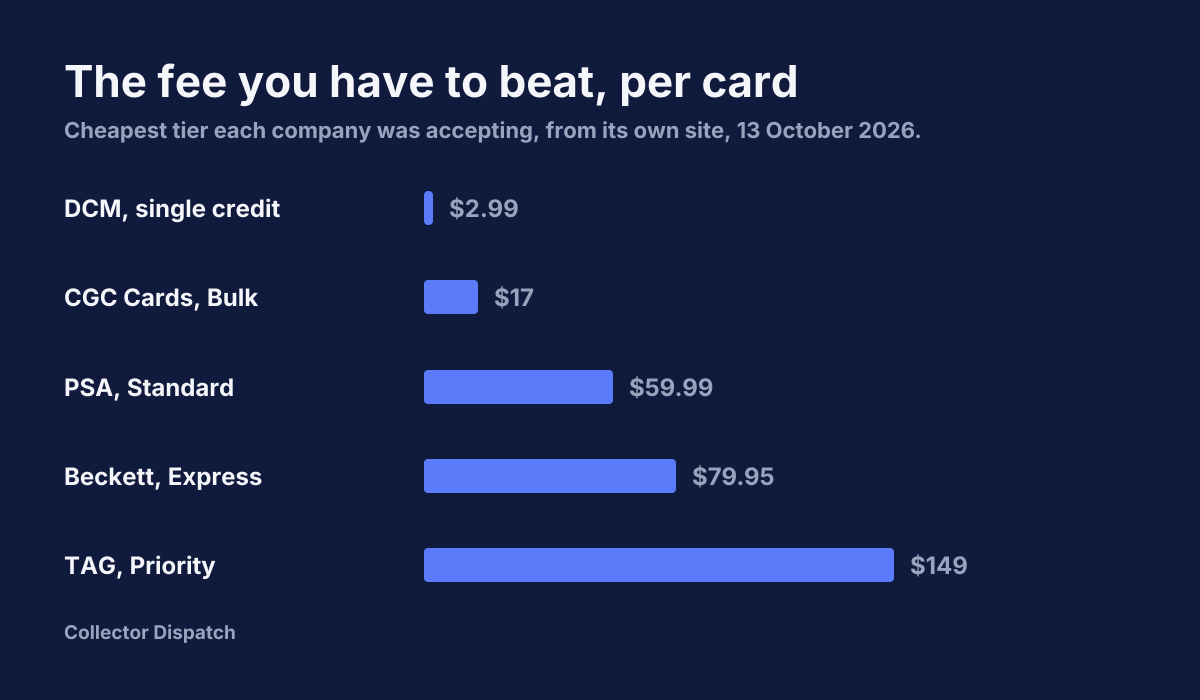
The fee is not the whole cost. Add postage and insurance both ways, roughly $20 on a small order, and the weeks or months the card is out of your hands and cannot be sold.
The sum
A graded card has to sell for more than the raw card would have, by at least the fee and the postage, before grading has done anything for you. Written out:
Graded price, at the grade you realistically expect, minus raw price, must be greater than fee plus postage.
Two parts of that sentence do the work. "Realistically expect" means the grade a card with that centring and those corners usually gets, not the top grade. And the raw price is what you could sell it for today, not what you paid.
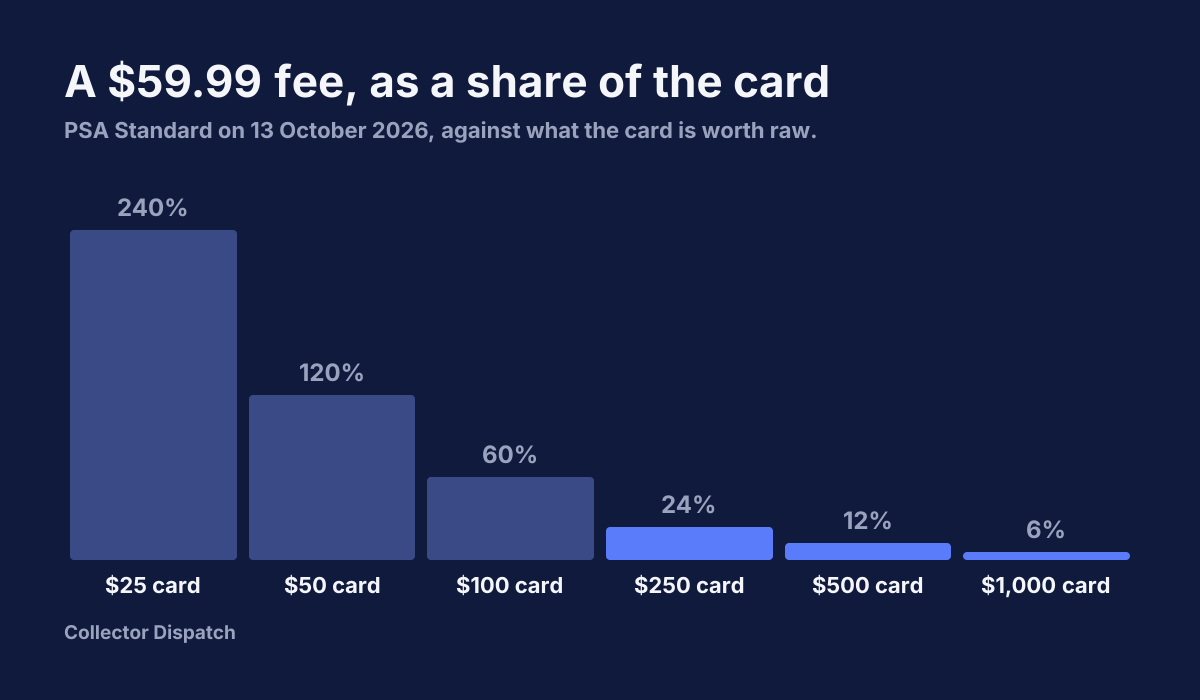
| Card is worth raw | Fee ($59.99) | Fee as a share of the card | Graded card must sell above (with $20 postage) |
|---|---|---|---|
| $25 | $59.99 | 240% | $105 |
| $50 | $59.99 | 120% | $130 |
| $100 | $59.99 | 60% | $180 |
| $250 | $59.99 | 24% | $330 |
| $500 | $59.99 | 12% | $580 |
| $1,000 | $59.99 | 6% | $1,080 |
On a $25 card the fee is 240% of the card: with postage, the graded card would have to sell for more than 4 times its raw price to break even. On a $500 card it is 12%, and a one-grade difference easily covers that. The line where it starts to make sense, at this fee, is somewhere around a $100 raw card with a real chance at a high grade.

Check the card before you check the price
Four things decide a grade, and you can assess all of them with a lamp and a magnifier.
Centring. Compare the borders left to right and top to bottom. Visibly off-centre is the commonest reason a clean card misses the top grade.
Corners. All four, under magnification. One soft corner is enough.
Edges. Chipping shows as white on a dark border. Chrome stock hides it less than you would hope.
Surface. Tilt the card under a light. Print lines, dimples and scratches on a foil surface are factory faults, and they count.
If the card fails any of those to the naked eye, it is not getting the grade that makes the sum work.
Volume changes the answer
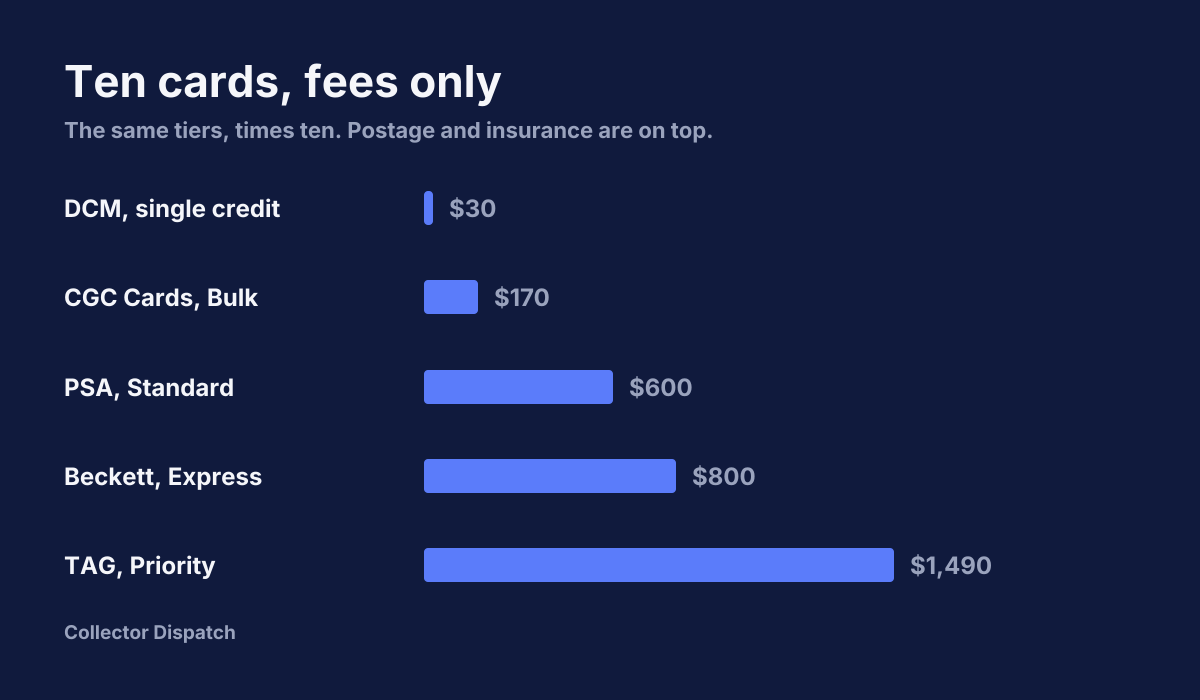
Ten cards at PSA Standard is $600 before postage. The bulk tiers are far cheaper per card and carry minimum orders and the longest waits, which is the trade.
When the answer is yes without the sum
You are selling to a stranger and the card is valuable. A sealed case from a company the buyer recognises is authentication as well as a grade. That is worth paying for on a card where a fake is worth making.
You want it protected and catalogued and do not intend to sell. Then the fee is the price of a case and a record. Choose on cost and convenience, because the resale argument does not apply to you.
When the answer is no
A modern base card. A card with a visible flaw. A card worth less than the fee. A card you are grading because everyone else seems to be.
Frequently asked questions
How much does a card need to be worth to be worth grading?
There is no fixed line, but the fee has to be a small share of the card. At PSA’s $59.99 Standard tier on 13 October 2026, that fee is 60% of a $100 card and 12% of a $500 card.
Does grading always increase a card’s value?
No. A mid grade on a modern card often sells for less than the raw price plus the fee. The premium concentrates in high grades and in cards people already want.
What should I check before sending a card to be graded?
Centring, corners, edges and surface, under a good light with magnification. A flaw you can see is a flaw the grader will see.