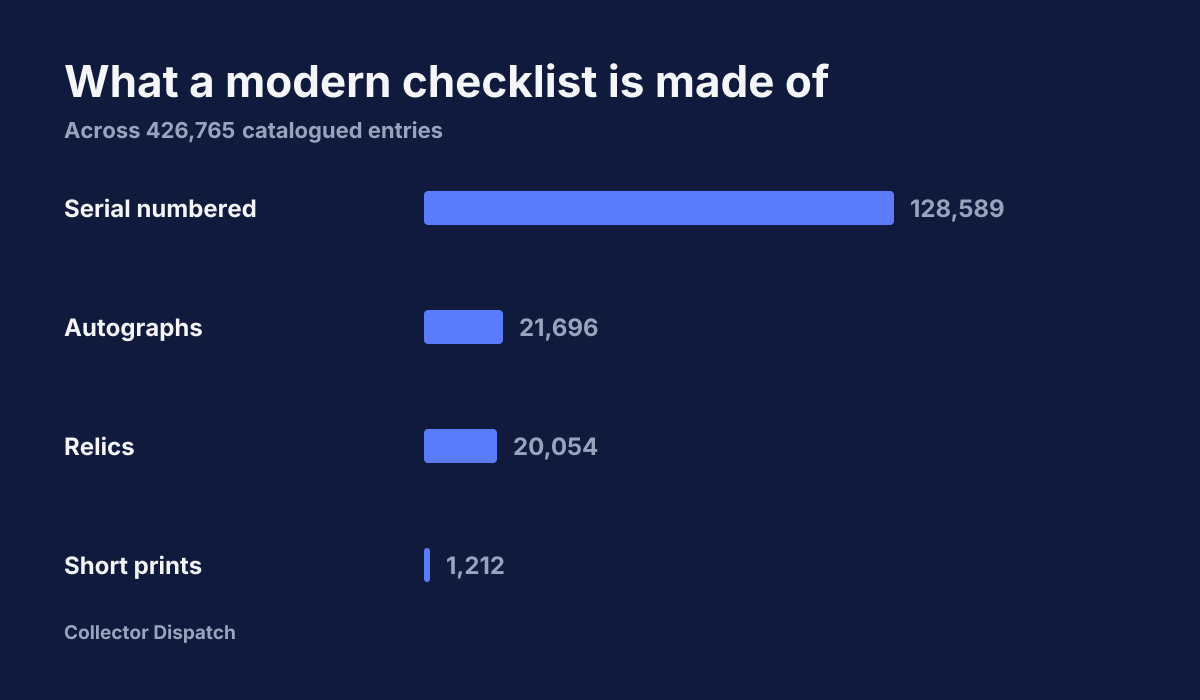
Four words carry most of the meaning on a modern checklist, and three of them get used to mean each other. Here is what each describes, how often it appears across the 426,765 cards we have catalogued, and which one is the only one that states a quantity.
| Term | What it describes | States a quantity? | In our database |
|---|---|---|---|
| Parallel | Same card, different finish | Only if numbered | Most of the 128,589 numbered entries |
| Insert | A different card from a themed subset | No | Own numbering per set |
| Short print | Printed in smaller quantity, amount unstated | No | 1,212 entries |
| Relic or autograph | Carries material or a signature | No | 20,054 relics, 21,696 autographs |
Parallel
The same card issued in a different finish. Same photograph, same card number, different surface, and usually a different print run. A parallel is its own entry on the checklist, which is the main reason checklists are so much longer than the number of players in them.
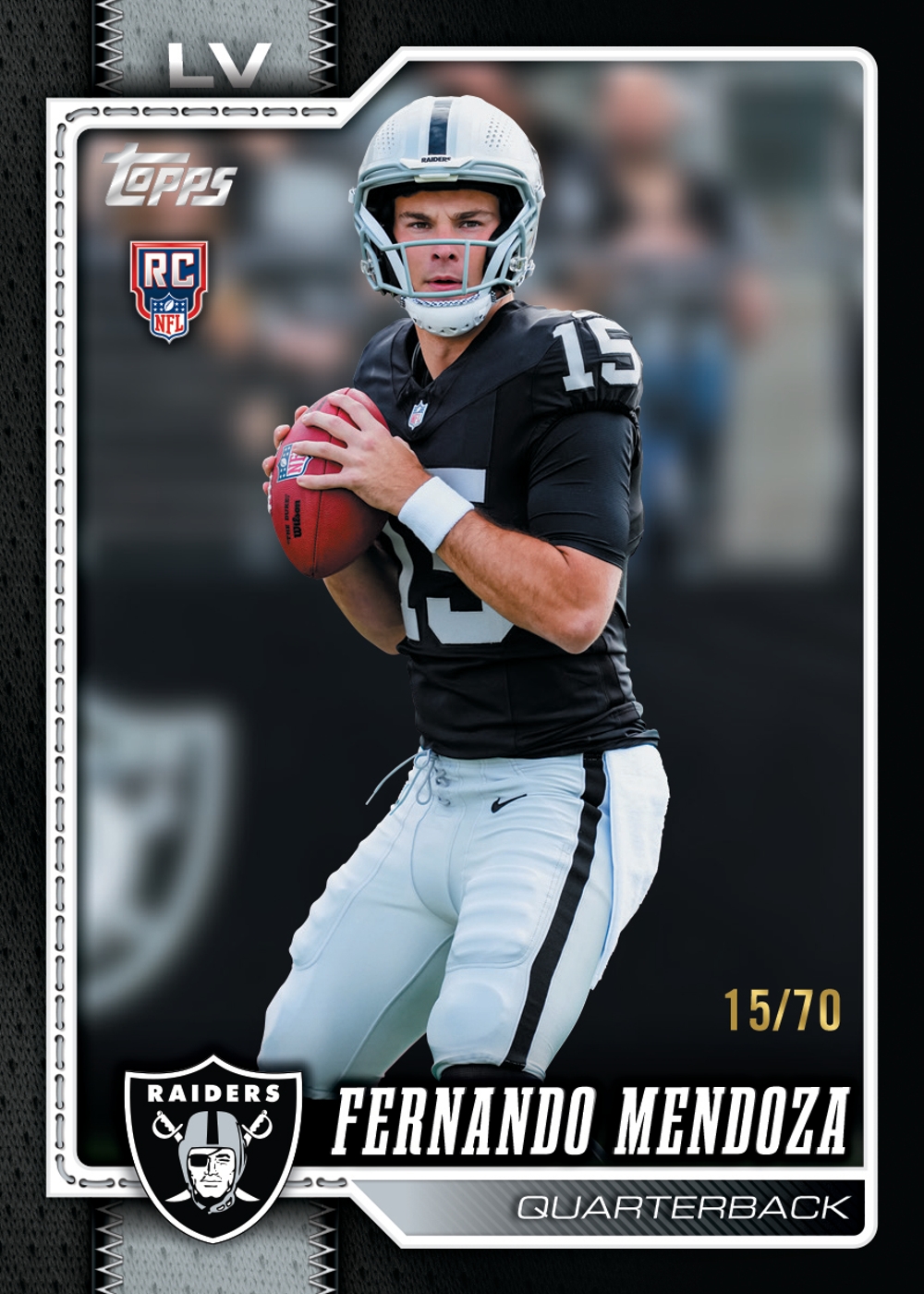
Parallels are where nearly all serial numbering lives. Of the 128,589 entries carrying a stated print run, the great majority are parallel finishes rather than base cards.
Insert
A card from a themed subset that sits alongside the base set rather than inside it. An insert has its own name, its own numbering sequence and usually its own odds line. Where a parallel is the same card wearing a different coat, an insert is a different card.
The test is the card number. If the number matches a base card, it is a parallel. If it belongs to its own sequence, it is an insert.
Short print
A card printed in smaller quantity than the rest of its set, without necessarily carrying a serial number. We have 1,212 entries flagged as short prints.
This is the slipperiest of the four, because it describes a decision rather than a stated number. A manufacturer is not obliged to say by how much, and often does not. A short print can be meaningfully scarcer than its neighbours or barely distinguishable from them, and the sheet will read the same either way.
Relic and autograph
A relic carries a piece of material, usually fabric. An autograph carries a signature, either applied directly to the card or collected on a label and applied afterwards. We hold 20,054 relic entries and 21,696 autograph entries, and the two overlap: a card can be both.
Neither word states a quantity. A signed card with no serial number tells you it is signed and nothing about how many exist.
So which one means rare?
Only the serial number. Parallel, insert, short print, relic and autograph all describe what a card is. The number describes how many there are. A card can be an autographed insert parallel and still be one of thousands, and the only way to know is the number that is or is not printed on it.
Frequently asked questions
What is the difference between a parallel and an insert?
A parallel shares a base card number in a different finish. An insert has its own numbering sequence and is a different card.
What is a short print?
A card printed in smaller quantity without necessarily stating how many. We hold 1,212 entries flagged as short prints.
Which term tells you how rare a card is?
Only a serial number states a quantity. The others describe what a card is, not how many were made.